

Research
Watching rock respond, pore by pore.
Physical, chemical and mechanical processes in porous media, studied by direct visualization of the dynamics.
How we see
Opaque soil becomes a window.
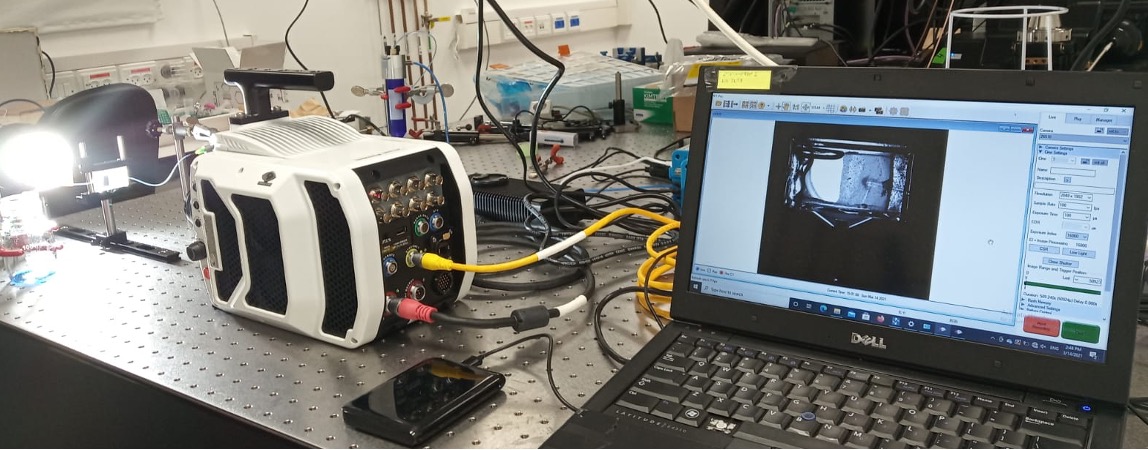
We replace opaque soil and rock with a transparent porous material developed in the lab. High-speed fluorescence imaging lets us quantify transport, chemical reaction, phase displacement and deformation directly.
01 · Deformation
Flow-induced deformation of porous rock
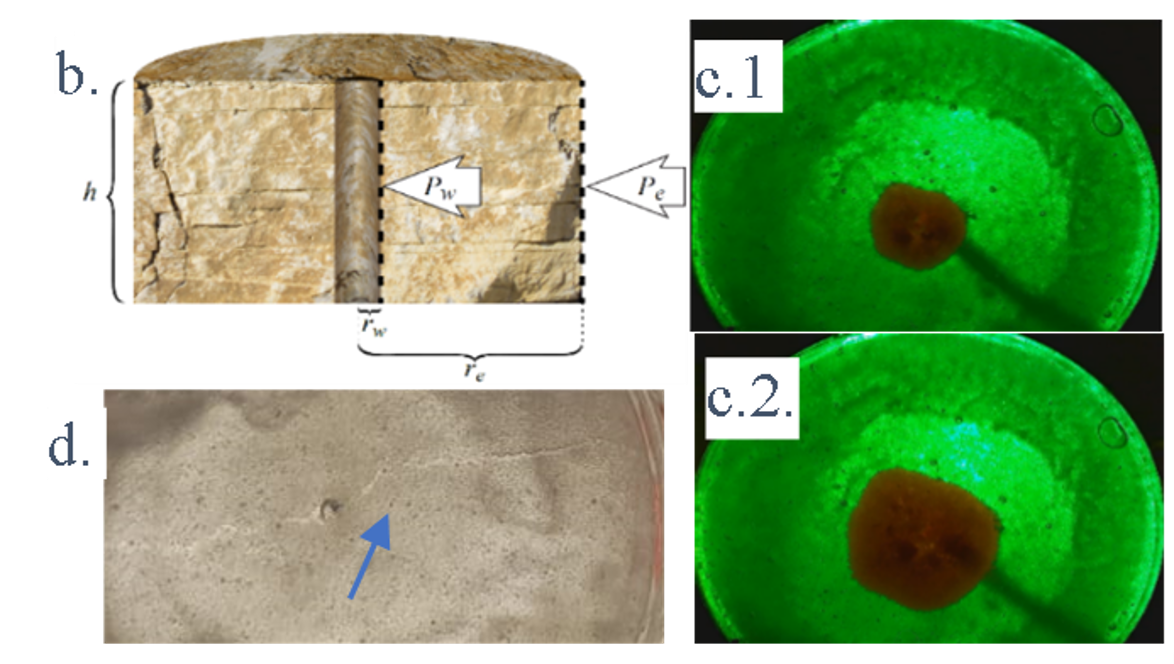
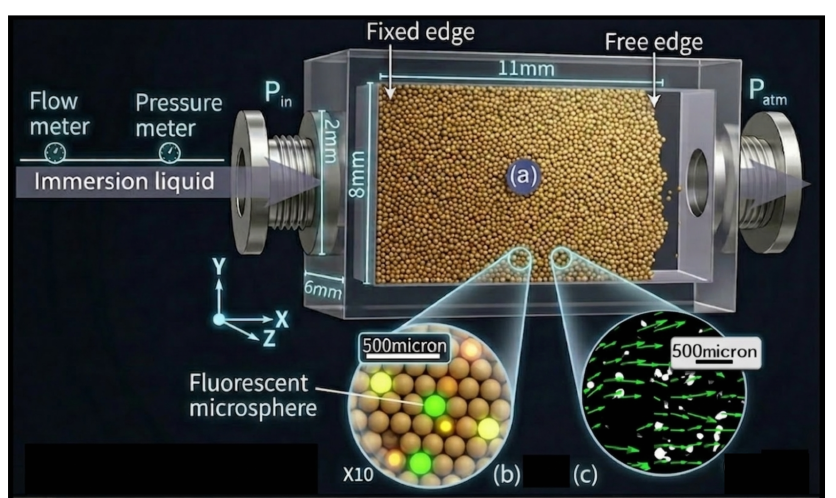
Injection for CO₂ sequestration, geothermal energy and wastewater disposal raises pore pressure and deforms rock. We track internal deformation and permeability as it evolves, in a sintered, rock-like transparent medium with embedded fluorescent particles.
- Flow alone can crush rock: pressurized flow makes compaction localize and couple with extensive shear.
- Afterwards the medium briefly loses stiffness, then recovers while it keeps compacting.
- Permeability evolves differently in ductile and brittle deformation.
Papers
Bachrach & Edery (2025). Flow-induced compaction localization in a rock-like medium. Geophys. Res. Lett. 52, e2025GL116207.
Bachrach & Edery (2023). Phys. Rev. E 108, L022901.
Sulieman et al. (2026). Permeability evolution of artificial rock during ductile and brittle deformation under pressurized flow. Geomech. Energy Environ. 48, 100893.
Loss of cohesion
Pressurized flow compacts and shears the pack until it loses cohesion.
PIV imaging
Particle image velocimetry tracks grain displacement inside the transparent pack.
Strain-field localization
Map of the strain component εyy showing where deformation localizes.
02 · Multiphase flow
Multiphase and miscible flow
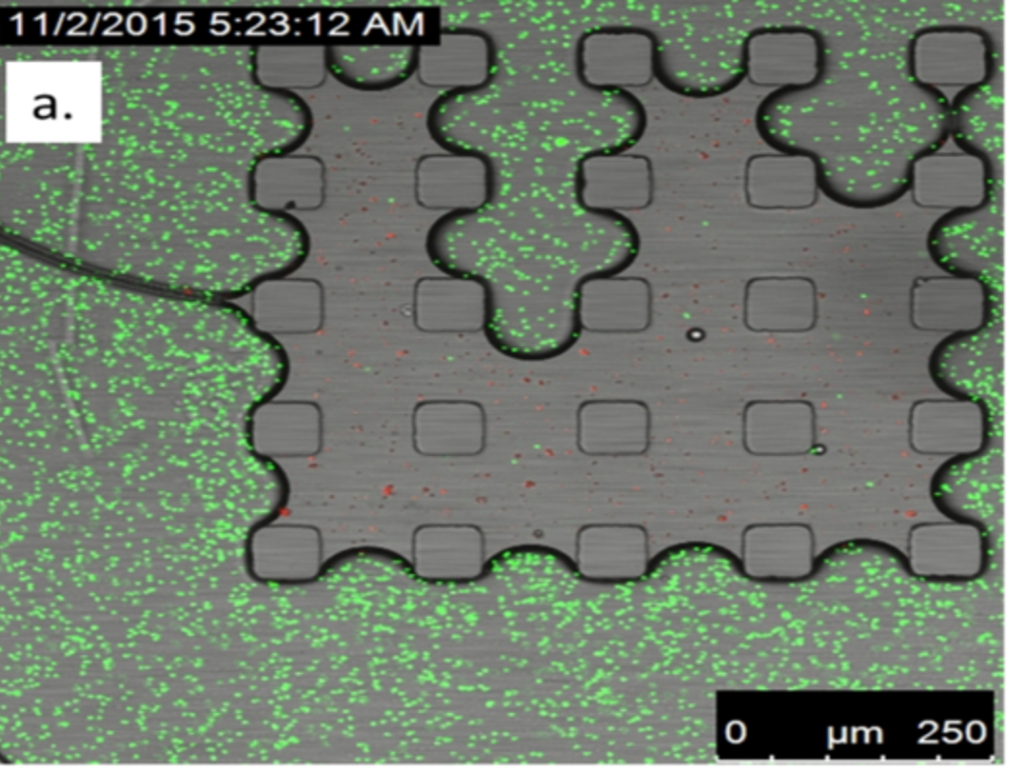
When one fluid displaces another in a porous medium, the pore structure and the driving pressure decide the pattern. We watch fingers form, fluids mix, and surfactants reopen paths that capillary barriers had sealed.
- Inlet pressure and heterogeneity turn a uniform front into fingers; a modified Sherwood number marks the switch.
- Surfactants keep the invasion going after breakthrough by reopening throats sealed by capillary barriers.
- Heavy-tailed pore-throat distributions start the secondary invasion sooner.
Papers
Eliyahu-Yakir, Abezgauz & Edery (2024). From mixing to displacement of miscible phases in porous media. Phys. Rev. Fluids 9, 084501.
Bhattacharjee, Ramon & Edery (2025). Phys. Rev. E 112, 065108.
Bhattacharjee, Ramon & Edery (2026). Phys. Rev. E 114, 025101.
Miscible displacement, experiment 2
Experiment 16.08.21 ex2.
Miscible displacement, experiment 4
Experiment 22.02.21 ex4.
03 · Reactive transport
Reactive transport
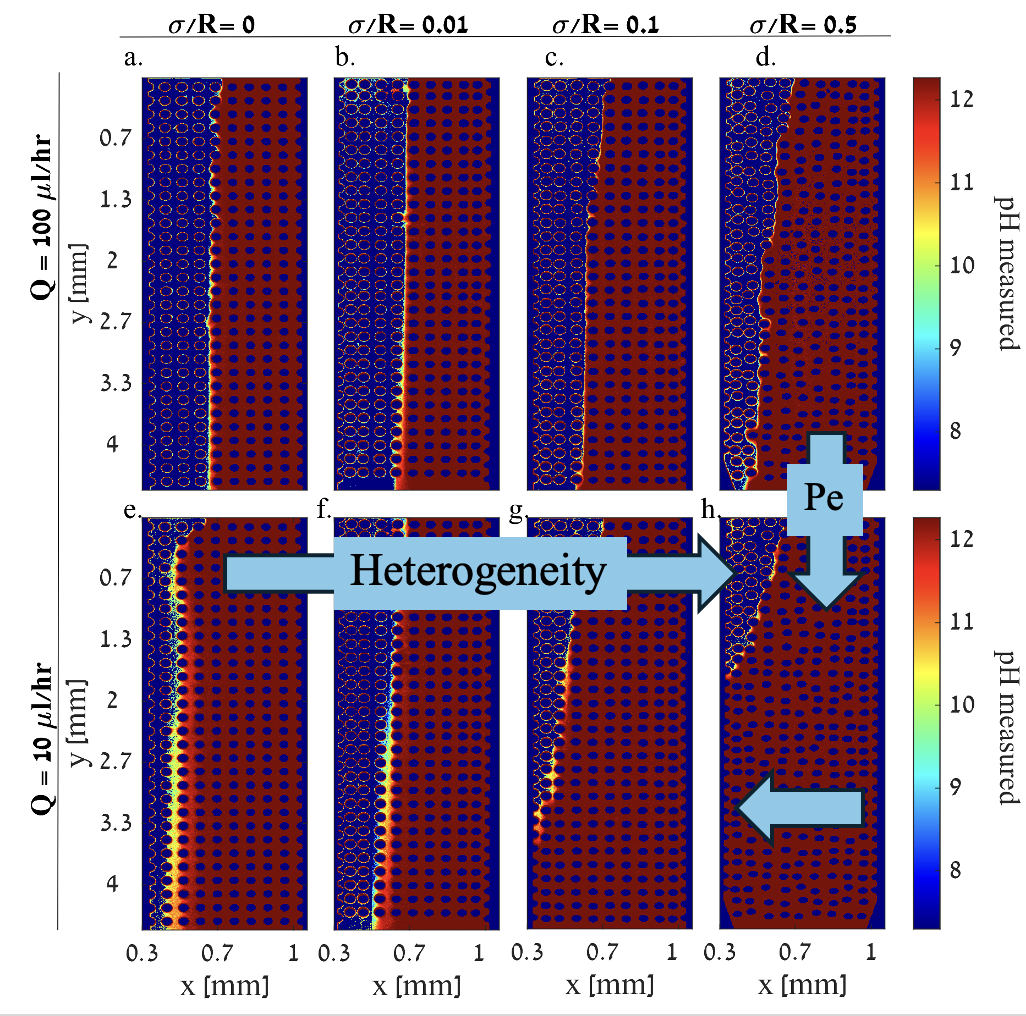
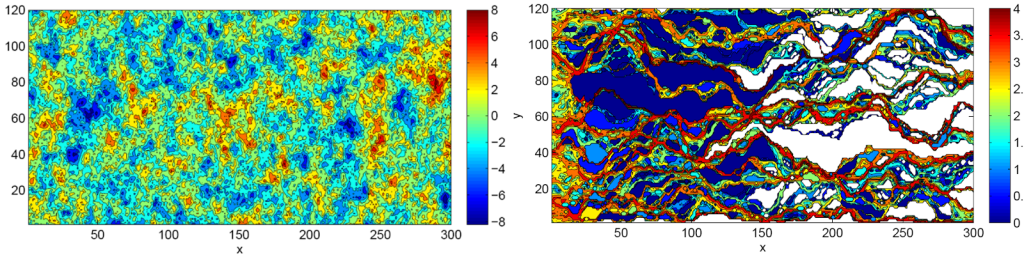
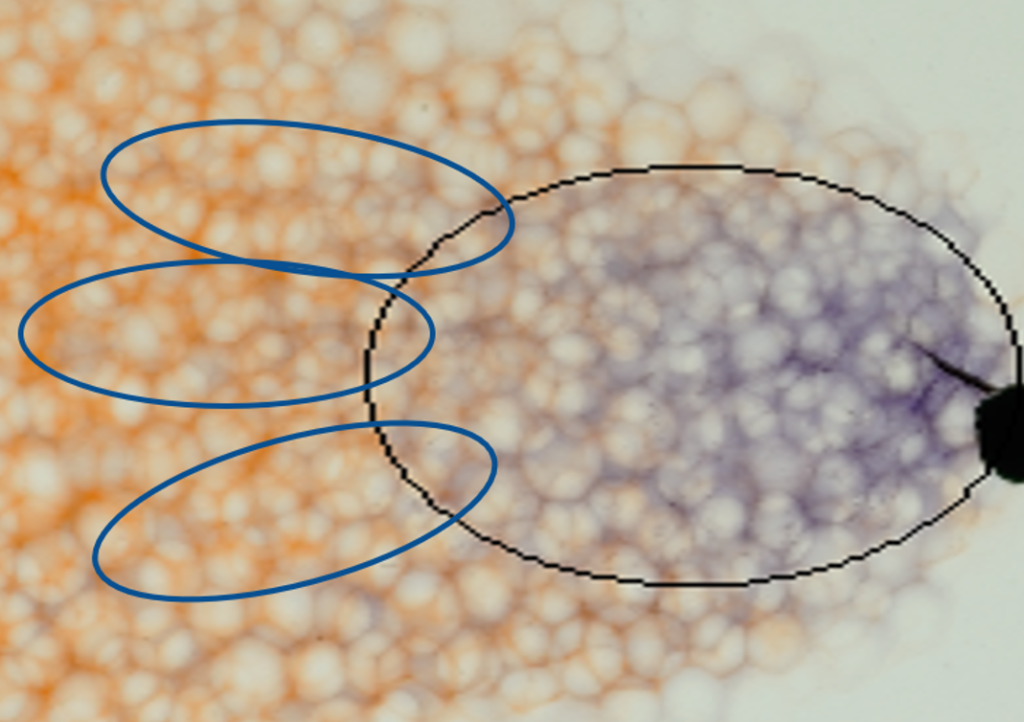
Mixing, dissolution and precipitation create preferential flow paths. We measure how transport organizes itself, with experiments in which pH is visualized directly and with simulations that quantify entropy and provide the basis for a non-equilibrium thermodynamics framework.
- pH equilibrates faster than transverse dispersion or diffusion predicts.
- Reaction and flow self-organize into preferential paths, most strongly when diffusion dominates (low Péclet).
- Paths split and rejoin: bifurcations, tortuosity and fractal dimension share one power law with heterogeneity.
Papers
Biran et al. (2024). Interplay between transverse mixing and pH reaction in porous media. Hydrol. Earth Syst. Sci. 28, 4755.
Shavelzon & Edery (2024). Shannon entropy of transport self-organization. Hydrol. Earth Syst. Sci. 28, 1803.
Shavelzon, Zehe & Edery (2025). Hydrol. Earth Syst. Sci. 29, 5625.
Dagan & Edery (2024). Bifurcating paths. Adv. Water Resour. 184, 104622.
Edery et al. (2021). Hydrol. Earth Syst. Sci. 25, 5905. · Zehe et al. (2021). Hydrol. Earth Syst. Sci. 25, 5337.
04 · Deformation memory
Rock remembers how it was pushed
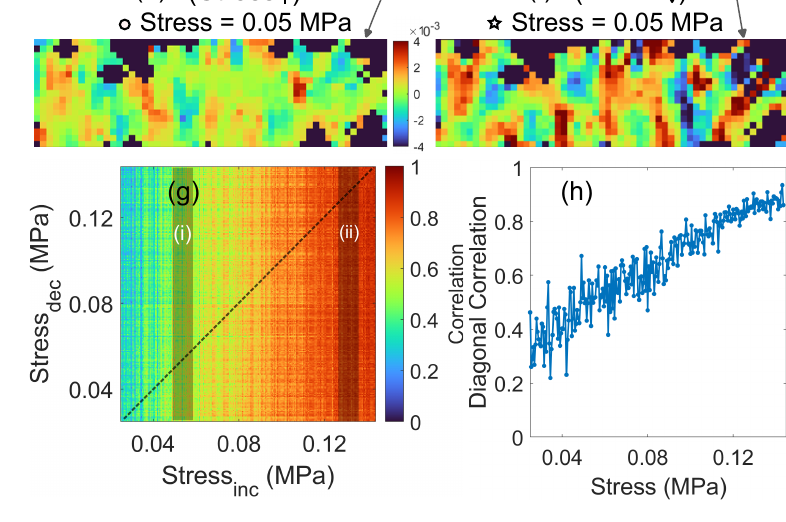
Cyclic injection repeatedly loads the rock with fluid pressure. Stress–strain curves show hysteresis but not where the damage sits, so we compare full strain maps of loading and unloading at the same stress.
- Same stress, different strain map: loading and unloading fields decorrelate as plastic strain builds.
- The strain correlation length grows with stress once the rock turns plastic.
- Lower permeability means longer correlation lengths.
Papers
Kundu & Edery (2026). Spatial strain correlations reveal irreversible deformation under increasing pressure cycles of a granular packing. Geomech. Energy Environ. 47, 100872.
Kundu, Bachrach, Sulieman & Edery (2026). Correlation-based detection of hidden deformation memory in a fluid-driven porous solid. Manuscript.
Join the lab
Come and see it for yourself.
We are always looking for M.Sc., Ph.D. and postdoctoral researchers. Not the smartest, but the ones with the most grit: those who deal with endless failures for that one sweet success.
רוצים לראות זרימה בתוך סלע? כתבו לנו.
Write to the lab →